

Students
- Unlimited practice with rigorous problems that don't repeat
- Instant feedback that encourages reflection and ownership
- Productive struggle that builds confidence and mastery
Derivita connects instruction, practice, assessment, and insights in one coherent system, from student and class to PLC, school, and district, seamlessly integrated with your LMS.

 Google Classroom
 Blackboard
License utilization, because Derivita meets teachers and students in the LMS where they already work every day
Percentile points, associated with one additional Derivita question answered per day*
Renewal rate, because districts expand, not just renew
*Independent ESSA Level III study by the International Centre for EdTech Impact, April 2026. Read the study
Take two minutes to watch how Derivita supports every level of math instruction.
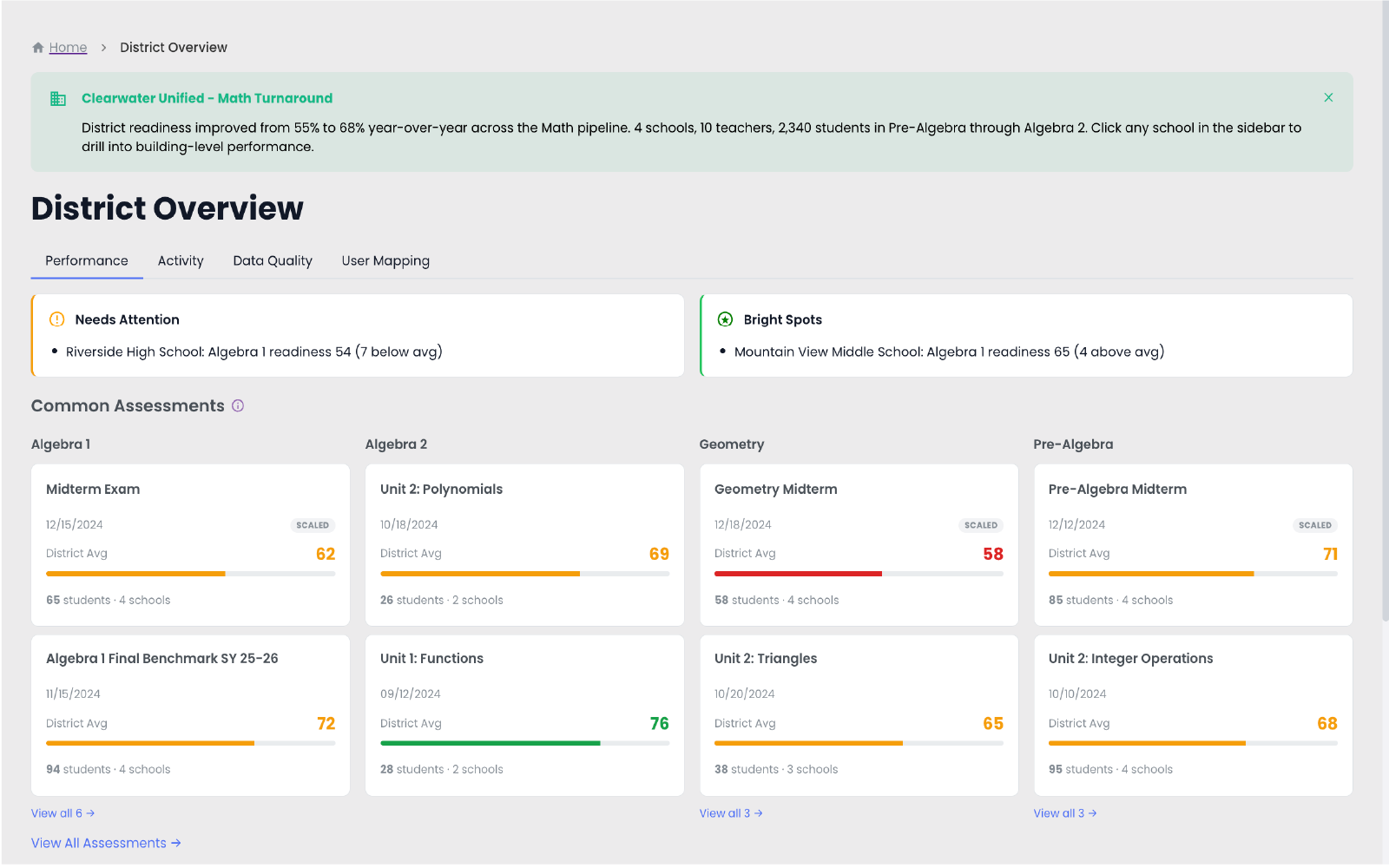
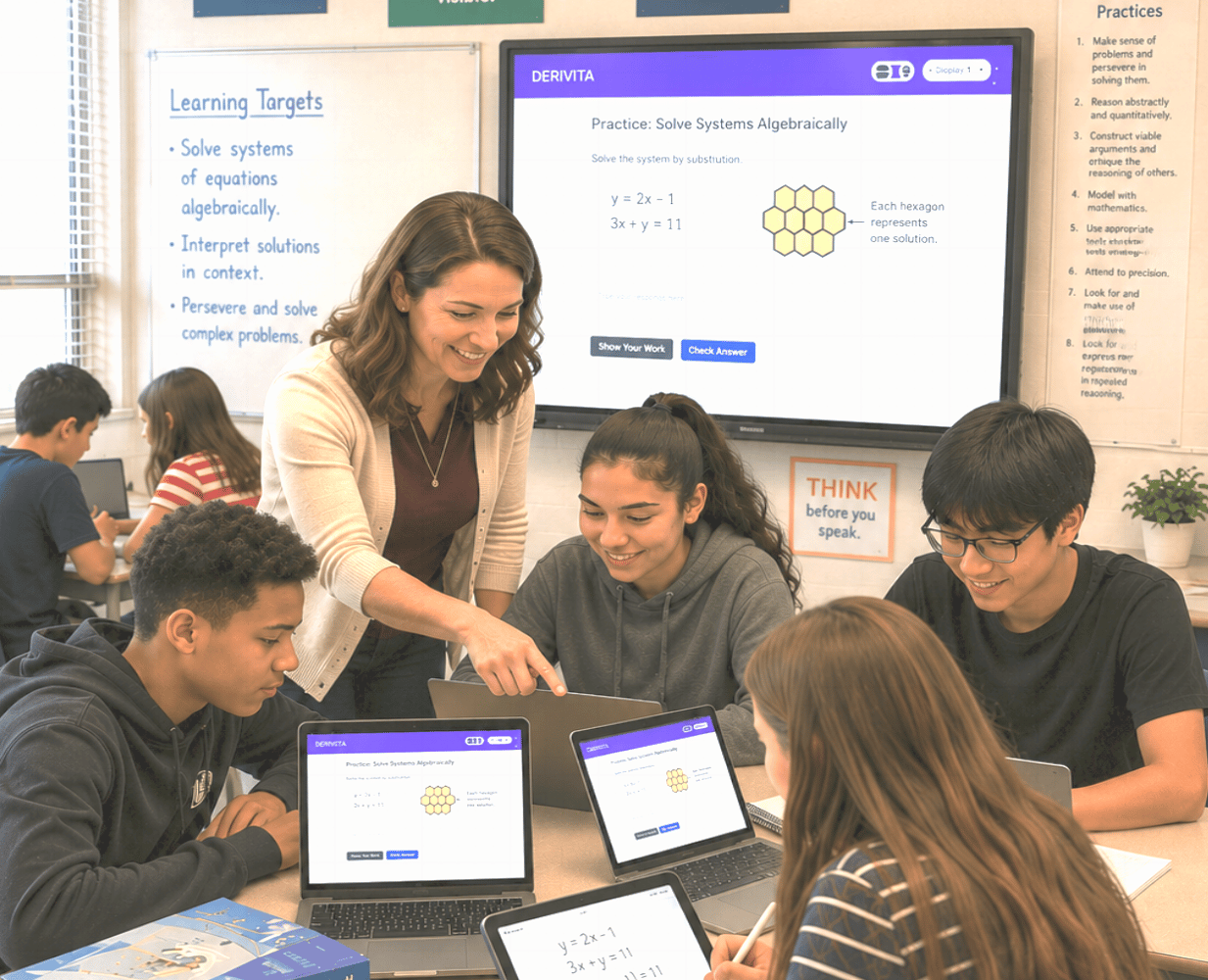
Real-time visibility across cohorts, schools, courses, and students, down to standards and individual items. It all comes from what students are doing right now, no waiting months to see results.
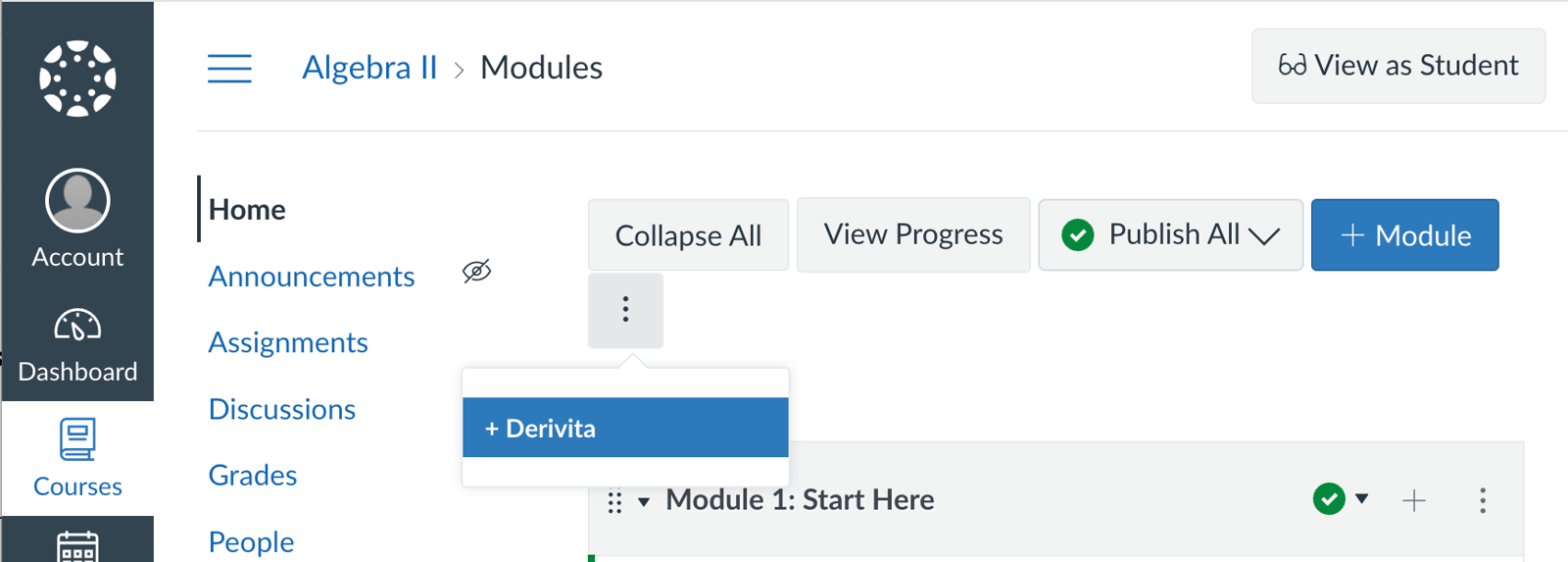
It starts in the LMS your teachers, students, and families already use. There's no new login for students and no separate platform to learn, which is a big part of why license utilization stays above 85%.
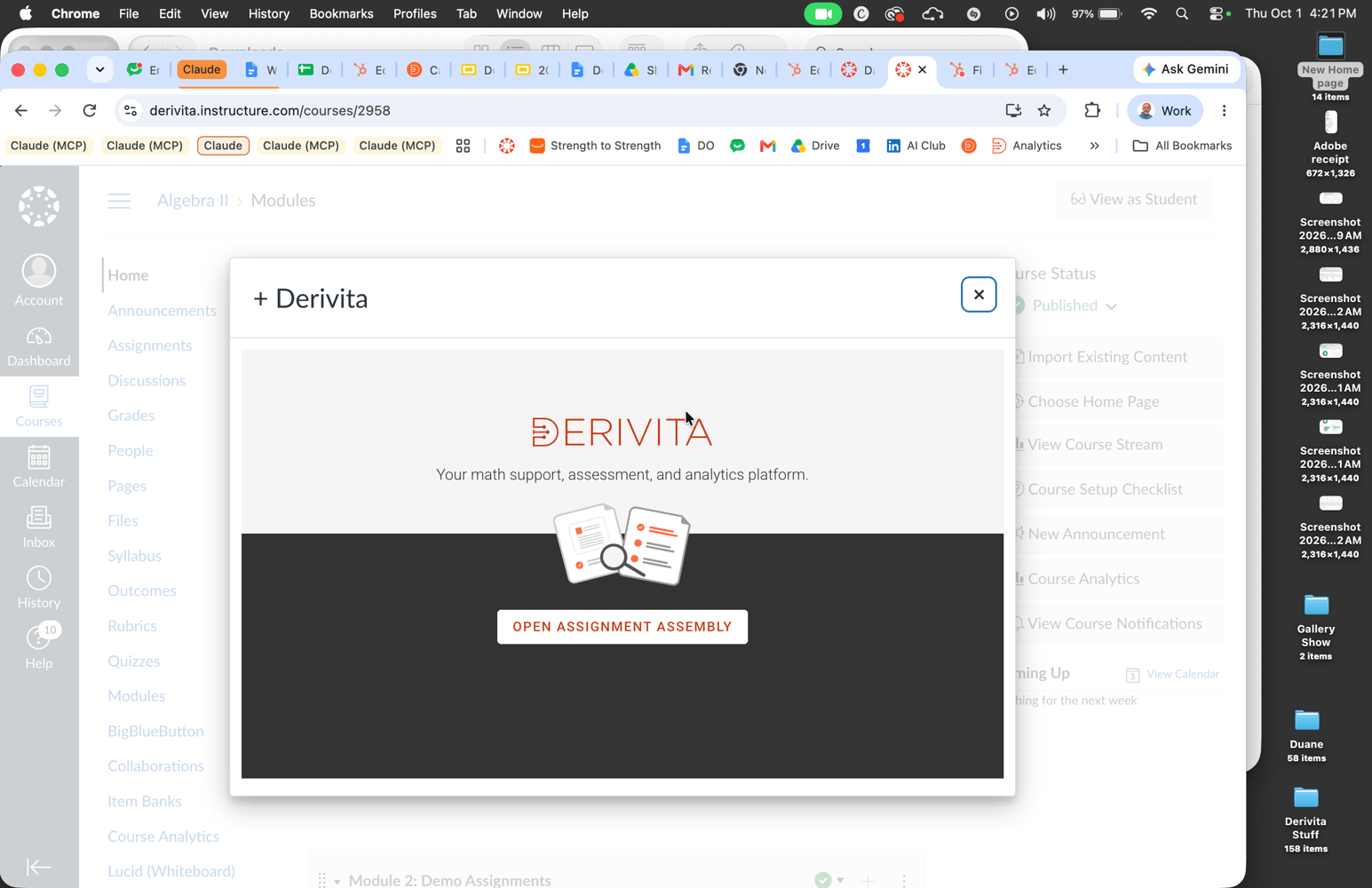
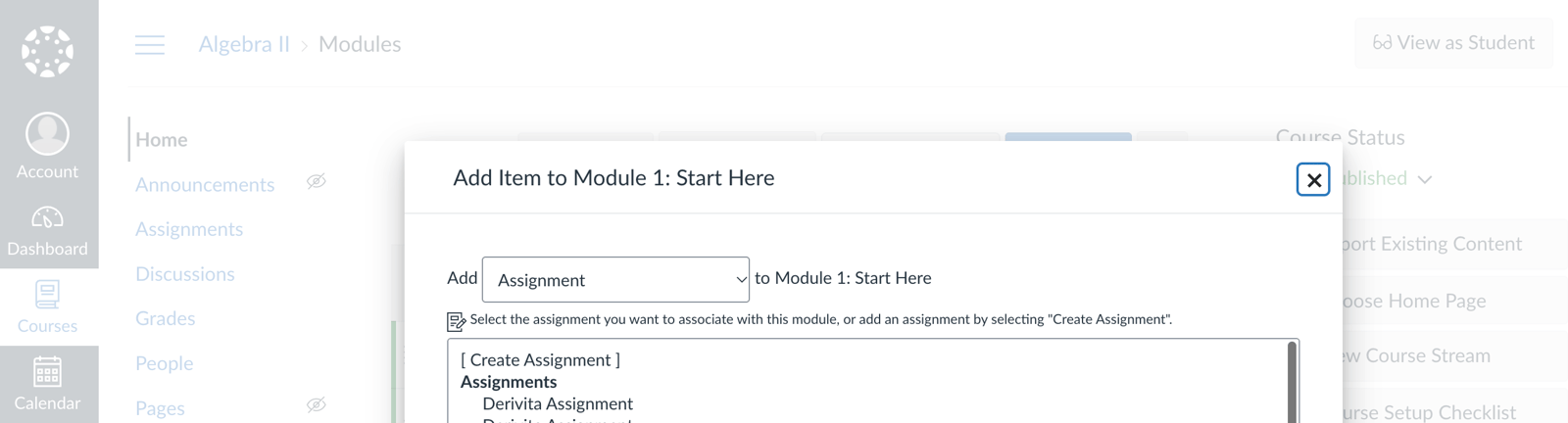
A teacher opens the course, opens Derivita, finds their curriculum, and goes to today's lesson, with questions aligned to exactly what they're teaching. They can also search by standard or topic, or write and adapt their own.
Every question runs on a math engine built for secondary math, which lets it do four things:
From the same library, teachers build bell ringers, homework, quizzes, and unit tests, all inside the LMS.
As students work, results come back in real time, and the teacher dashboard shows where attention is needed most.
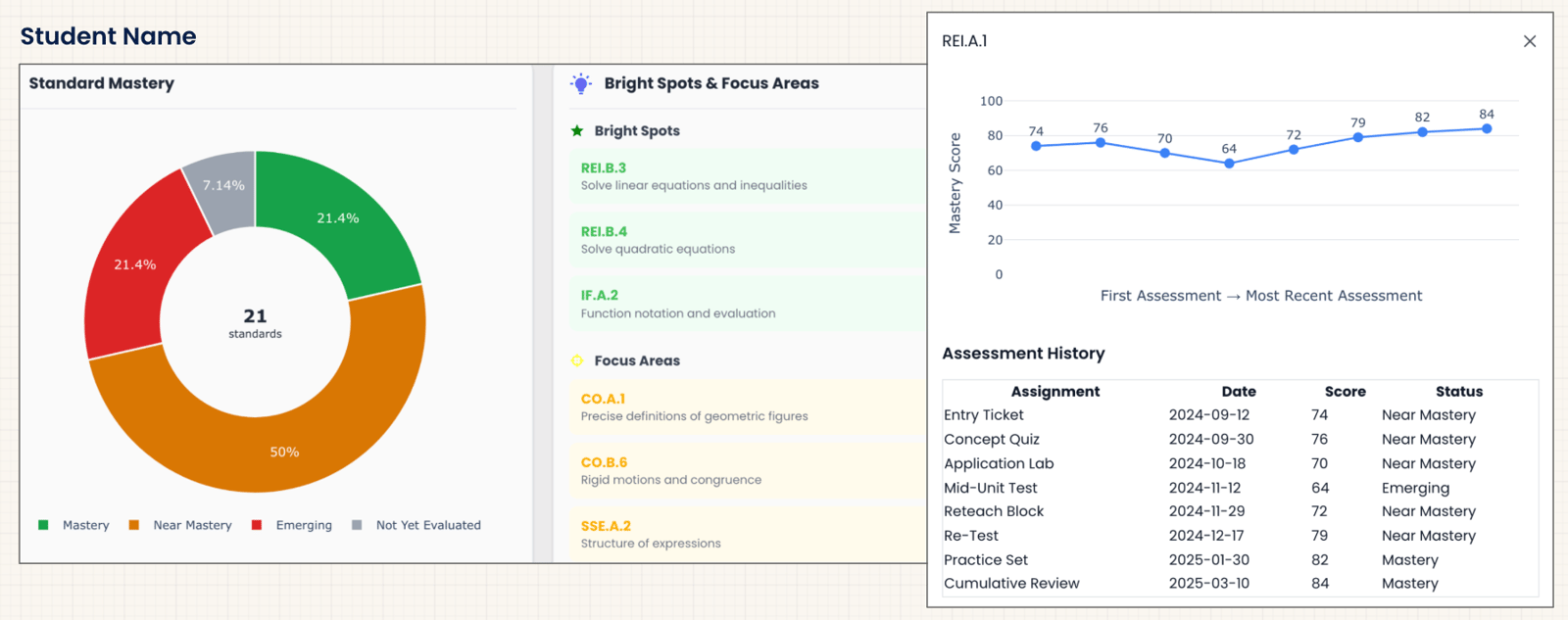
When a concept isn't landing, a teacher opens SpotCheck, pulls a question up, and students join with a QR code, ready for a Building Thinking Classrooms routine. Students can participate without being singled out, which is often when quieter students start talking.
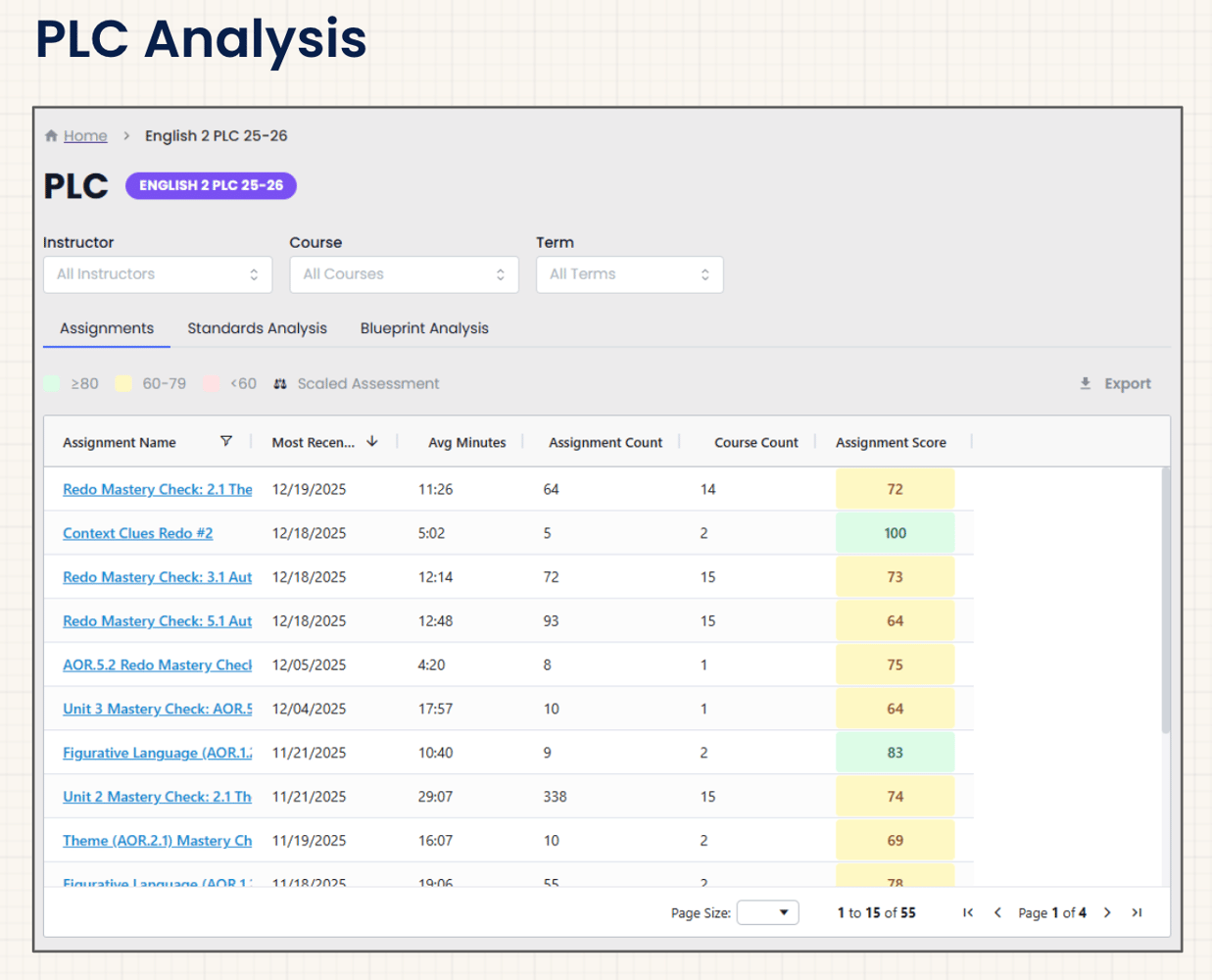
Build and share lessons and common assessments from one shared library, keeping teachers aligned on the math they teach and measure. Collaborative planning gives every teacher a strong foundation, and extra support for those less confident creating lessons on their own.
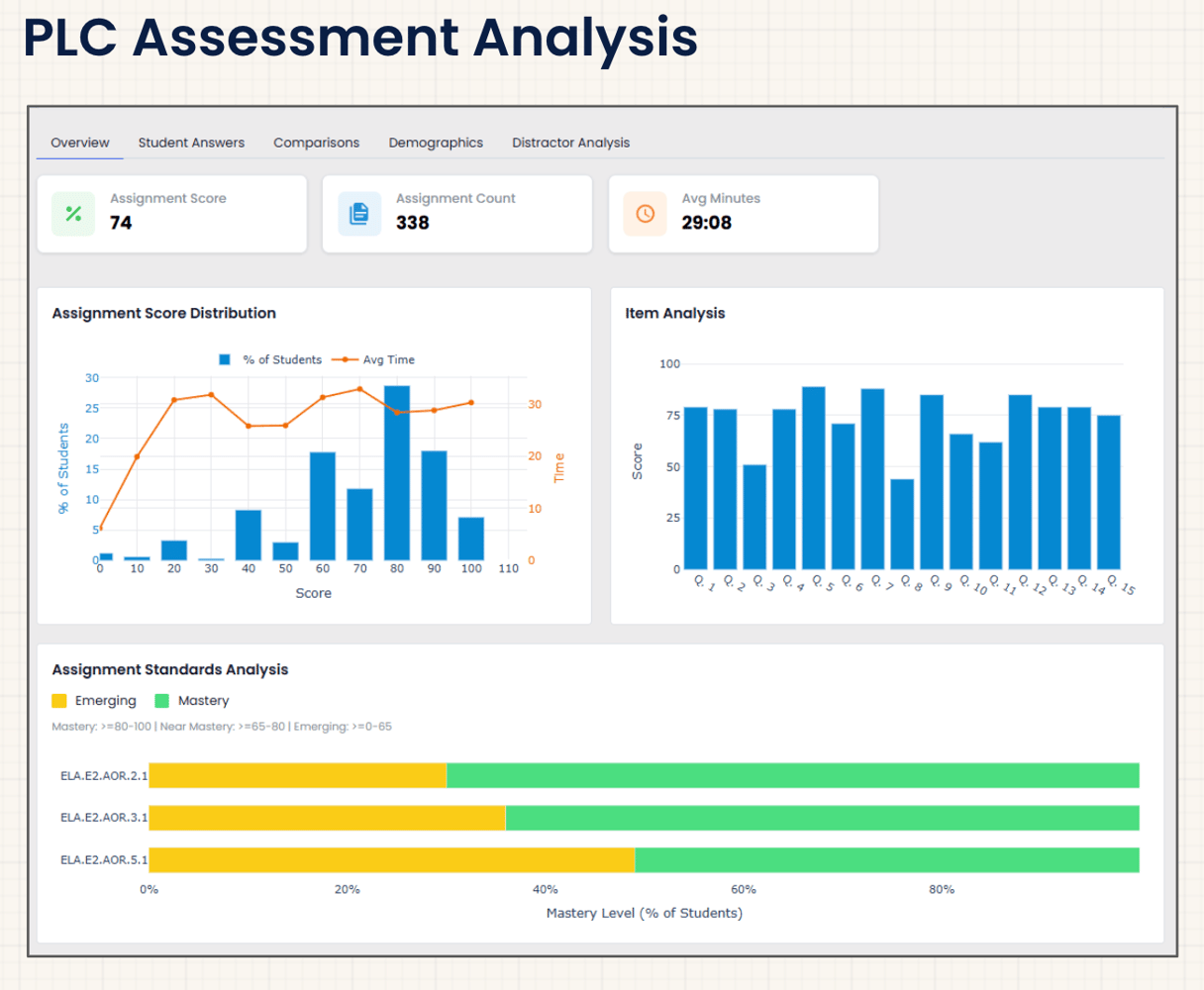
Common assessment data rolls up on its own, so the PLC meeting starts with evidence instead of spreadsheets.
"Your kids did better on number seven than my kids. Why?"Rachel Marshall, Middle School Math Specialist, Canyons School District, UT
Which brings us back to where we started. Every number comes from daily instruction, so leaders can see it while there's still time to act. One system, from the student to the district.
Every teacher. Every student. We believe change at that scale takes more than a collection of disconnected tools. It takes a coherent system, one that connects the questions students answer to the decisions teachers, PLCs, and leaders make every week.

Derivita becomes part of daily instruction at every level, district-wide. It starts with expert-authored questions and a math engine built for secondary math. Everything students, teachers, PLCs, and leaders do builds on that foundation.
Because every level works from the same questions and the same data, a student's answer on Tuesday can inform a teacher's plan on Wednesday, a PLC conversation on Thursday, and a district decision the following week.
A coherent system, not a supplement.



In many districts, secondary math runs across a practice product, an assessment platform, PLC spreadsheets, and a separate reporting layer, each with its own login, training, and data. Derivita can bring that work into one system inside the LMS, which helps reduce training, support, and vendor overhead.
"Derivita has revolutionized our assessments by simplifying the process for both teachers and students… This data has enabled us to effectively address the individual needs of all of our learners."

"They're having conversations like, 'Your kids did better on number seven than my kids. Why?'… That's been a really powerful tool to model what a PLC should really look like."

"The feedback part of Derivita is fantastic. It's so empowering… It's not like Ms. Thomas has to be hovering, explaining every little misconception."

No curriculum to replace. No new login for students. Derivita becomes part of the everyday teaching and learning routines your teachers, students, and families already know.
Your Partner Success Manager handles LMS setup with your administrator, then trains your team in three one-hour sessions inside the LMS.
For practice, homework, and assessments, aligned to the curriculum they teach.
In the LMS they already know and use daily.
In your LMS, with data updated automatically.
Across cohort, school, class, student, standard, and item.

Questions are aligned lesson by lesson to the core curricula districts have chosen and to state standards, so practice and assessment reinforce the same progression teachers are already teaching.
Derivita was built from the start to live inside the LMS your teachers and students already use every day. That's a big part of why adoption holds, and why districts spend less time on training and support.
Blackboard"LMS-integrated" covers three quite different technical arrangements, and the differences show up in adoption. Our guide walks through all three, and the ten questions worth asking any platform you evaluate, including this one.
Compare the three LMS integration models ESSA Level III study, International Centre for EdTech Impact, April 2026
A 2026 independent ESSA Level III study found that one additional Derivita question answered per student per day is associated with a 13-percentile-point gain on end-of-course math assessments: a student at the 50th percentile would be expected to perform at the 63rd.
A student at the 50th percentile, answering one additional Derivita question per day
Associative finding measured on end-of-course math assessments.
Schools and districts using Derivita









We believe math is a reasoning discipline, and that software should respond to student thinking the way a strong math teacher would. Seven principles guide how Derivita's questions and math engine are designed.
Math develops reasoning, not memorization. Students need to construct, explain, and justify, not just choose from a list. Derivita is built to ask those questions, and to understand the answers.
Where most platforms stop: questions with a single, exact, predictable answer, because higher-order and open-ended questions need a math engine to grade.
How Derivita supports it: 150,000+ grades 6 through Calculus III questions written by in-house math and curriculum experts, including open-ended, multi-step, and conceptual questions that call for real mathematical reasoning.
Mastery takes repeated, varied practice across multiple contexts. Derivita provides the depth to support a full, rigorous curriculum and the breadth to differentiate, so teachers have meaningful practice and assessments to assign.
Where most platforms stop: question banks that repeat quickly, leaving little to assign when extra practice, differentiation, or a retake is needed.
How Derivita supports it: the math engine generates variations that preserve mathematical intent and consistent difficulty, so students can practice toward mastery and assessments can vary from student to student.
A student who writes y − 7 = 2(x − 1) isn't wrong. They used point-slope form. Accepting mathematically equivalent answers means students spend their energy on mathematics, not on satisfying formatting rules.
Where most platforms stop: rigid syntax matching, where a different but equivalent form, added parentheses, or an extra space gets marked wrong.
How Derivita supports it: the CAS evaluates mathematical equivalence across forms, notations, and solution paths, including open-ended questions with multiple valid answers, so students can answer in the language of math.
Students deserve to know how their answer is being read before they submit. A live preview builds trust, so students focus on the math instead of second-guessing the input.
Where most platforms stop: notation is ambiguous (is 9/x+1 equal to 9/(x+1), or (9/x)+1?), and students are marked wrong when the system reads an expression differently than they intended.
How Derivita supports it: a live preview updates on every keystroke, showing exactly how Derivita is reading the expression, so students aren't penalized for how an expression was parsed.
The student who added exponents instead of multiplying made a different mistake than the one who got the coefficient wrong. Feedback that speaks to the actual error closes the loop.
Where most platforms stop: the same "Incorrect" message for every wrong answer, and open-ended questions that either can't be graded or need teacher time to score by hand.
How Derivita supports it: because Derivita understands the response, it can address the specific error, distinguishing a conceptual gap from a procedural slip, and grade every valid form of a correct answer automatically.
The best math teachers know how every student is doing because they've seen their whole body of work: homework, classwork, and responses all year long, not just a year-end test.
Where most platforms stop: practice and assessment treated as separate activities, with data that rarely connects and only a few high-stakes snapshots a year.
How Derivita supports it: every practice session, homework set, and assessment adds to a cumulative record of where each student is and where they're headed, so teachers have evidence to act on all year.
A question answered by a student is also a data point for a teacher, a PLC, a school leader, and a district. That insight should flow automatically, without manual exports or separate reporting tools.
Where most platforms stop: data stays in the product that generated it, visible to a student or teacher but rarely aggregated in a way school and district leaders can use.
How Derivita supports it: real-time dashboards surface mastery patterns from individual responses up to district-wide benchmarks, giving teachers, PLCs, and leaders a connected picture of math performance.
Derivita integrates natively with Canvas, Google Classroom, Schoology, Moodle, Blackboard, and D2L, so students and teachers work inside the LMS they already use rather than a separate login. Derivita was co-founded by Devlin Daley, co-founder of Instructure, the company behind Canvas, and built from the ground up to work within existing LMS platforms. See how the three integration models compare.
Derivita covers grades 6 through Calculus III with open-ended, conceptual questions that are graded automatically for mathematical equivalence, not just multiple choice.
Derivita gives district leaders real-time analytics dashboards across every school, alongside native LMS integration, so rollout doesn't require a separate system for IT to manage.
A secondary math improvement system connects the questions, practice, assessment, and data a district uses for middle and high school math, so every level of instruction works from the same content and the same evidence. Derivita is a district-wide math improvement system for grades 6 through Calculus III that runs natively inside the LMS, supporting students, teachers, PLCs, and district leaders in one coherent system rather than a collection of separate tools.
No. Derivita enhances the curriculum a district has already chosen, with questions aligned to curricula such as Illustrative Mathematics, Open Up Resources, and Big Ideas Math, and to state standards including CCSS, Texas TEKS, and Florida BEST. Teachers keep their curriculum and instructional model, and Derivita adds practice, assessment, feedback, and connected data around it.
An independent 2026 ESSA Level III study by the International Centre for EdTech Impact found that one additional Derivita question answered per student per day is associated with a 13-percentile-point gain on end-of-course math assessments: a student at the 50th percentile would be expected to perform at the 63rd. Read the ESSA Level III study.
Bring Derivita to your district evaluation committee. We'll bring the ESSA Level III evidence, and show how Derivita enhances the curriculum, LMS, and standards they've already chosen.